
Reflecting on a Weekend Honoring and Marching Alongside Civil Rights Leaders
The truth is that our troubled times are more precedented than we might care to admit - and we can draw courage and inspiration from the heroes of the Civil Rights Movement.

On Friday, I went to Chicago to join thousands of participants, ranging from current and former heads of state to ordinary worshipers from around America, gathering to pay our respects to the family and honor the memory of the Rev. Jesse Jackson at the House of Hope on the city’s South Side.
Watching his historic presidential campaign on television as a child, I never imagined that I would one day get to know Rev. Jackson personally. From the first time we met during my 2020 campaign, to the discussions and engagements we had on access to transportation and infrastructure jobs during my time as Secretary, I learned a great deal from him - and came in particular to admire his unflagging focus on the future.
Even though his place in history was secure by the time of his thirtieth birthday, and even as his body failed him late in life, he never tired in fighting to advance racial and economic justice, always pressing America to come nearer to its highest ideals. His example is especially important for us all in these times.
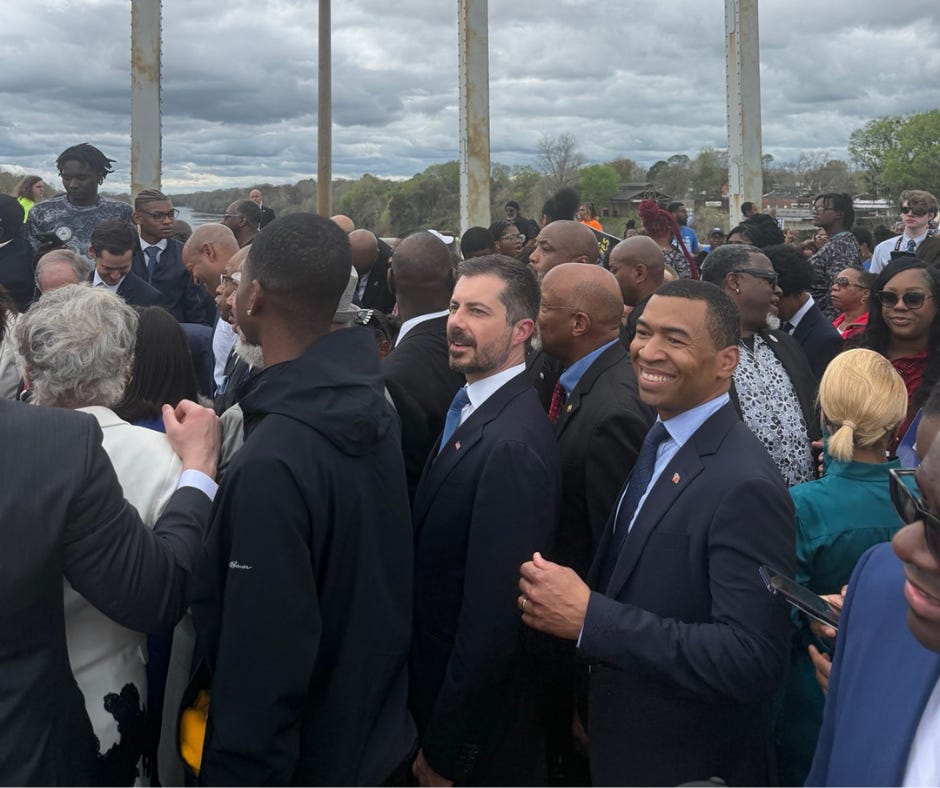
Of the personal memories of Reverend Jackson that I carry, some of the strongest come from walking at his side at the commemoration of Bloody Sunday in Selma, Alabama. That commemoration was held once more this weekend, and his spirit was on everyone’s minds as we gathered near the Edmund Pettus Bridge on Sunday.
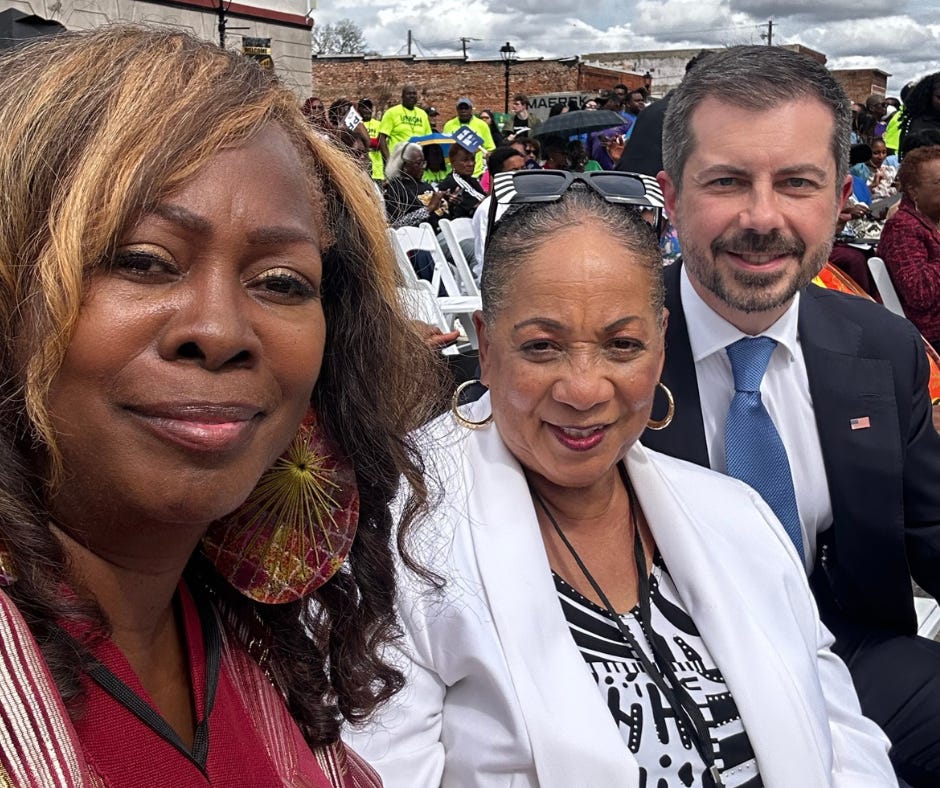
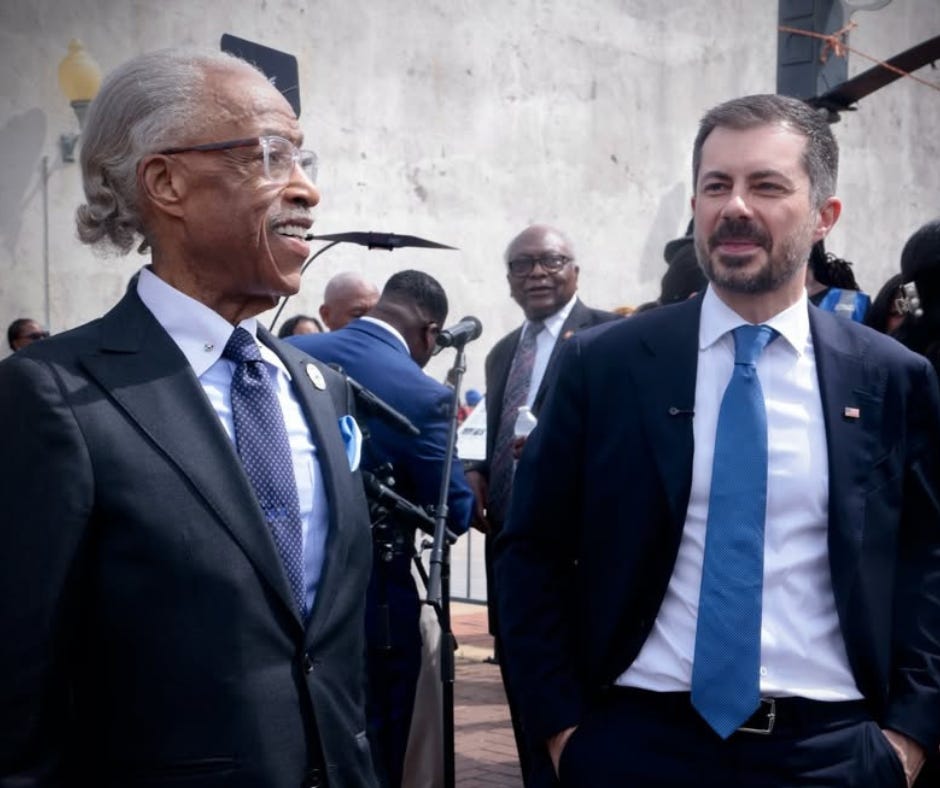
First came the Martin & Coretta King Unity Breakfast, where I had the honor of sharing a few reflections. (You can watch my remarks or read the full text below.) Then, in the historic Tabernacle Baptist Church, words and prayers called us to do right by the memory of those heroes who put everything on the line in that historic struggle.
Later, on the bridge itself, where about six hundred civil rights marchers in 1965 faced down brutal violence with nothing to protect them but their unyielding faith and the justice of their cause, we marched and sang, in a throng that ranged from children participating for the first time, to some of the civil rights foot soldiers who were there themselves on that historic day.
Being in the presence of those moral giants was both humbling and inspiring. Their physical courage, and their irrepressible sense of hope and faith, leave our generations with no excuse to back down or check out in our own time. We have our work cut out for us, and will until America truly lives up to its promise of liberty and justice for all.
-
Thank you. Dr. Griffin, good morning.
Thank you for the warm welcome. Thank you, Senator [Hank] Sanders and Faye Rose Touré for the invitation to be here and acknowledge so many great leaders here, including the mayor, my fellow mayor. So glad to see the work that you’re doing here in the city. Members of Congress, including Mr. Clyburn and Terri Sewell. And I’m mindful of the memory of Dr. LaFayette being with us as we gather.
It is fitting today, more than ever, that we hold in mind the events of 61 years ago that have forever linked the name of Selma with the struggle for civil rights and racial and economic justice in America. And we know that maintaining that memory is important today, partly because we are beginning to see how much effort has gone into suppressing the memory and the history of what has happened in this country.
From university courses about Black history to museums and National Park Service sites like the home of Medgar and Myrlie Evers and the Emmett Till National Monument, we are seeing the keepers of history being pressured to censor depictions of the struggle under the slanderous excuse that telling the truth about our past is, quote, “disparaging America.”
Nothing could be further from the truth.
When we recognize the struggle of the heroes of Bloody Sunday, we are honoring America in its best sense, because the best thing that has happened in America is the courage of those who saw America’s promise clearly enough that they could not tolerate the way things were.
The past and the present are always interconnected.
It’s part of why, when I had the honor of serving as Secretary of Transportation, I worked with Congresswoman Sewell to bring $36.6 million here for the Selma to Montgomery Trail. Now I wish I was just here mentioning that to take a victory lap about it, but that funding was canceled by the current administration in a budget that redirected those dollars toward tax cuts for billionaires and more federal agents on our streets.
But we will not give up on that project nor will we give up on the importance of recognizing our own history.
And in all of the work ahead of us we need to insist that things become better, not just better than today but better than before. And in this we can emulate those moral giants—not just their physical courage in standing up for what they fought against, but their clarity in what they were fighting for.
They were not just fighting against the long arm of the Confederacy, against the mockery of justice that was Jim Crow, against the way things were—they were fighting for the future that Dr. King envisioned and described.
They were fighting for what America ought to, and still might, become.
And so must we.
This is hardly the first season in which the wealthy have made themselves more and more powerful in collusion with the powerful making themselves more and more wealthy—all at the expense of political equality and economic opportunity.
Today, we use words like “unprecedented,” but the truth is our times are more precedented than we would care to admit.
So amid the abuses of this moment, we’ve got to be clear that we are not working to restore some old status quo. We are not trying to make America anything “again.” Because there is no “again” in the real world.
We are here to deliver something new, which means when we do look to the past, we recognize the quality of the heroes like Dr. King, and like John Lewis, and like Jesse Jackson and so many others—it was how focused they all were on the future.
And they counsel us not to give up.
They don’t just say “don’t give up.”
They say “don’t you dare give up.”
Knowing what they were up against, we do not have the right to give up on the struggle for voting rights.
We do not have the right to give up in the struggle for universal health care, or affordable child care, and affordable housing for everybody.
We have no right to give up in the fight for high-quality, fully funded public schools, or our demand that the wealthy pay their fair share in taxes, or our insistence that if you use deadly force on American streets, you must at the very least get a warrant and show your face.
We do not dare give up our work building what must be built for the future.
Sometimes we run the risk of looking at those moral giants of the past and ourselves shrinking a little bit, because how could we ever measure up.
But the other way to think about it is to look at those examples of the past and not be paralyzed, but propelled.
And Scripture has a little bit to say about this, because in the book of Hebrews, we are reminded of those great prophets of old, and they are called for us “a cloud of witnesses.”
Hebrews 12:1 tells us: “Therefore, since we are surrounded by such a great cloud of witnesses, let us throw off everything that hinders and the sin that so easily entangles, and let us run with perseverance the race marked out for us.”
The race is marked out for us in our time. And how dramatically so.
So are we ready to throw off everything that hinders and run that race marked out for us and do it well?
I know that we are.
Thank you so much for the opportunity to be here. Thank you.
-
Thank you Pete for constantly keeping us on our feet! Love everything about you!! Keep it up 👍
I agree, talking about our errors is not a weakness but a way to correct them. It is hardly disparagement, but a sign of great strength.
Wonderful to meet you at the Edmund Pettus Bridge yesterday.